Choosing China’s top Aluminium Door With Window manufacturer requires more than comparing catalog photos and export prices. A reliable supplier should show practical experience, controlled production, and clear project evidence. Look for factory records covering residential towers, hotels, offices, and coastal homes. These projects reveal how products perform beyond a showroom.
Details matter. Ask about aluminium alloy grades, profile thickness, thermal breaks, glass specifications, drainage design, and hardware brands. A professional manufacturer should explain air tightness, water resistance, wind-load calculations, and sound insulation in understandable terms. Independent test reports can strengthen confidence, but buyers should verify their dates, laboratories, and tested product models.
The factory process also deserves attention. Check extrusion quality, powder-coating consistency, corner joints, gasket installation, and final inspection records. Small defects can become large maintenance problems. A dependable supplier normally provides shop drawings, samples, installation guidance, packaging photos, and responsive after-sales support.
No manufacturer is perfect. Even experienced teams may face color variation, glass delays, or installation errors. Honest communication matters more than polished promises. Ask how the supplier handles damaged units, design changes, and missed tolerances. Request references from comparable climates and building types.
Cost is important, but the lowest quotation may hide thinner profiles, weaker hardware, or limited service. A balanced evaluation considers durability, compliance, delivery control, and long-term value. This guide examines the qualities that distinguish leading Chinese manufacturers from ordinary trading sources, while recognizing that every project needs careful verification.
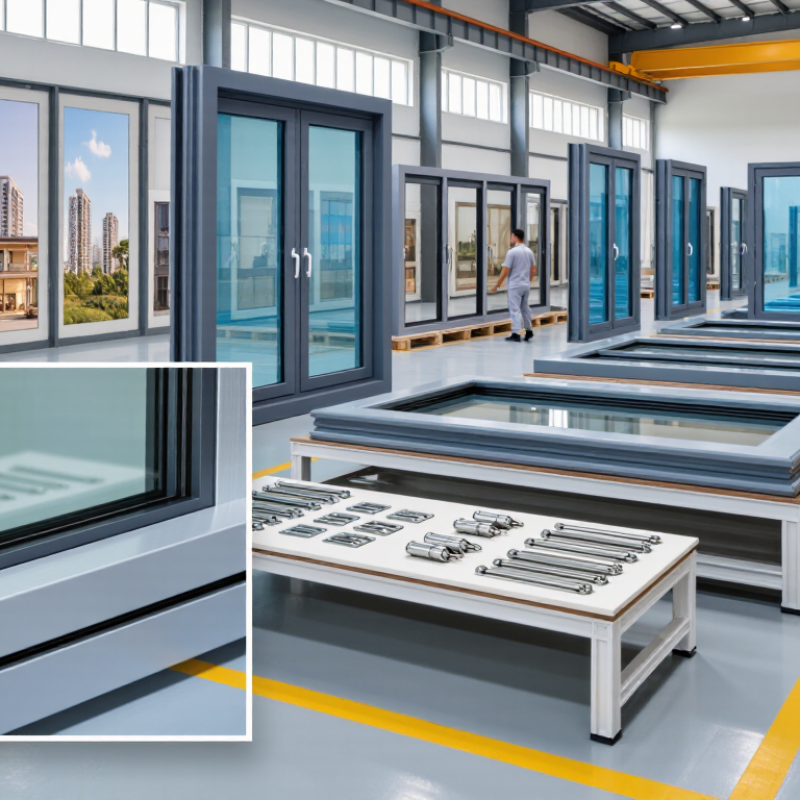
A top aluminium door and window manufacturer in China is defined by more than attractive product photos. Real experience appears in completed projects, stable production, and careful responses to unusual site conditions. A reliable manufacturer should explain alloy grades, profile thickness, thermal breaks, glass options, drainage design, and hardware performance clearly. Vague answers are warning signs.
Professional knowledge also shows in testing and quality control. Strong factories inspect incoming aluminium, monitor surface treatment, and check dimensions before packing. They may provide test data for air tightness, water resistance, wind pressure, and sound reduction. Ask for factory videos, sample corners, inspection records, and references from similar climates. A serious supplier will discuss installation details, not only product prices.
Tips Compare samples under natural light. Check corner joints, locks, seals, and frame alignment by hand. Request a written specification before ordering. Confirm packaging, replacement parts, and after-sales communication. A small sample can reveal large production problems.
No factory is perfect. Even experienced manufacturers may overlook a detail when drawings are incomplete or local measurements change. The better ones admit this risk and use drawing reviews, trial assemblies, and inspection checkpoints to reduce mistakes. Their authority comes from repeatable processes, trained staff, transparent documents, and dependable communication. A top manufacturer earns trust before shipment and protects it after installation.
A top Chinese aluminium door and window manufacturer should be judged by measurable standards, not attractive catalogues. The UNEP 2023 Global Status Report states that buildings consume about 34% of global energy and create roughly 37% of energy-related emissions. This makes thermal performance a commercial issue, not merely a design preference. Request verified U-values, air leakage results, and thermal-break details for the exact profile and glass combination.
Supplier evaluation should begin with factory evidence. Check whether testing follows GB/T 7106 for airtightness, watertightness, and wind resistance. For overseas projects, compare results with EN 14351-1, ASTM E283, and ASTM E331. Ask for laboratory reports showing specimen size, pressure levels, test dates, and failure observations. ISO 9001 certification supports process control, but it does not prove every window performs well. That distinction matters.
Inspect aluminium alloy certificates, coating thickness, hardware origin, and batch traceability. A serious supplier should identify each order through production records and inspection photographs. Visit the assembly line if possible. Watch sealant application, corner crimping, drainage paths, and glass packing blocks. Small details decide field performance. A polished sample can still hide inconsistent machining. I would not trust a quotation without a signed performance schedule, replacement terms, and a realistic installation guide. Even experienced buyers sometimes overlook packaging tests, although damaged corners can ruin an otherwise compliant product.
| Evaluation Dimension | Recommended Benchmark | What to Verify | Relevant Standard or Test Method | Evaluation Result |
|---|---|---|---|---|
| Product Standard Compliance | Finished aluminium doors and windows should be designed and tested against the project’s required national or international standard. | Check the product specification, test report scope, test sample configuration, date of testing, and issuing laboratory. | GB/T 8478-2020 for aluminium alloy doors and windows; EN 14351-1 may be applicable for European projects. | Pass / Review The cited standard must match the actual product and market. |
| Aluminium Alloy Profile | Profile chemistry, dimensions, mechanical properties, and surface condition should conform to the specified alloy and temper. | Verify alloy designation, temper, wall-thickness drawings, dimensional inspection records, and material certificates. | GB/T 5237.1-2017 for general requirements of wrought aluminium alloy extruded profiles. | Documented Require traceability from batch number to finished assembly. |
| Profile Wall Thickness | Use the engineered wall thickness stated in the approved drawings; structural sections should not be substituted with thinner profiles. | Measure random sections with calibrated vernier calipers or ultrasonic equipment and compare them with approved drawings. | Project drawings, approved shop drawings, and applicable requirements in GB/T 8478-2020. | Measured Acceptance limits should be agreed before production. |
| Surface Finish | Colour, gloss, coating thickness, adhesion, and appearance should remain within the approved sample range. | Review coating process records, colour sample approval, coating thickness readings, adhesion results, and visual inspection criteria. | GB/T 5237.2-2017 for anodized profiles; GB/T 5237.4-2017 for powder-coated profiles; GB/T 5237.5-2017 for PVDF-coated profiles. | Sample Approved Colour approval should be completed before mass production. |
| Thermal Performance | Select a whole-window U-value suitable for the project climate; lower U-values generally indicate better heat-transfer resistance. | Confirm frame, glass, spacer, seal, and size configuration used in the calculation or laboratory test. | ISO 10077-1 and ISO 10077-2 can be used for thermal transmittance calculations. | Project-Specific Do not compare U-values unless the same size and glass configuration are used. |
| Air Permeability | The tested air-leakage classification should meet or exceed the project specification. | Check pressure sequence, specimen size, leakage values, classification, and whether the test covered the complete window or door assembly. | EN 12207 classification; ASTM E283 may be used for air-leakage testing. | Test Required Hardware, gaskets, and installation gaps can affect the final result. |
| Watertightness | The assembly should resist the specified static or dynamic water pressure without unacceptable leakage. | Review pressure level, test duration, spray pattern, drainage design, and observed leakage location. | EN 12208 classification; ASTM E331 is commonly used for water-penetration testing. | Test Required Testing should use the same drainage and seal design as production units. |
| Wind Load and Structural Safety | The frame, mullions, transoms, glass, fasteners, and anchors should be engineered for the project wind pressure and span. | Request structural calculations showing design pressure, deflection, glass thickness, reinforcement, and anchor spacing. | ASTM E330/E330M or EN 12210 may be used according to the project specification. | Calculation Required Building height, exposure, opening size, and local wind code must be considered. |
| Glass Specification | Glass type, thickness, safety treatment, spacer, gas filling, and performance must match the approved schedule. | Verify glass certificates, heat-soak or tempering records where applicable, visual quality, thickness, and insulating-glass seal condition. | EN 12150 for thermally toughened glass; EN 1279 for insulating glass units; applicable local glass standards may also apply. | Schedule Matched The glass specification must be checked together with frame performance. |
| Hardware and Operating Cycles | Hardware should be compatible with the sash weight, opening type, corrosion environment, and required operating frequency. | Check hardware load rating, corrosion protection, locking points, spare-parts availability, and cycle-test records. | EN 1191 for operational forces and repeated opening tests; project hardware specification should control acceptance. | Function Tested Inspect locks, hinges, rollers, handles, restrictors, and drainage paths. |
| Fabrication Accuracy | Cutting, machining, corner joining, mullion alignment, sash fit, and drainage should comply with approved shop drawings. | Use an inspection plan covering dimensions, diagonals, corner joints, sealant application, drainage holes, and visible defects. | Approved shop drawings, factory inspection plan, and applicable tolerances in the project specification. | In-Process Control First-article approval should precede batch production. |
| Quality Management | A documented quality system should control purchasing, production, inspection, nonconformities, and corrective actions. | Review quality certificates, internal audit records, calibration records, inspection plans, and corrective-action reports. | ISO 9001:2015 provides a framework for quality-management systems. | System Verified Certification alone does not prove product performance. |
| Factory Capacity and Lead Time | Capacity should be demonstrated with actual production records rather than stated monthly output alone. | Check equipment list, production routing, current workload, sample-to-production lead time, packaging process, and delivery history. | Purchase contract, approved production schedule, inspection plan, and shipment records. | Capacity Audited Confirm capacity for the required profile, glass, finish, and opening types. |
| Packaging and Logistics | Units should be protected against abrasion, impact, moisture, distortion, and incorrect identification during transport. | Inspect corner protection, separators, wrapping, crate strength, labels, loading method, and container moisture control. | Approved packing specification and project logistics requirements. | Packing Approved Packaging should be validated with the intended transport route. |
| Installation and After-Sales Support | The supplier should provide installation details, adjustment instructions, replacement-parts support, and a documented warranty process. | Review installation manuals, interface details, site-support plan, spare-parts list, response time, and warranty exclusions. | Project installation specification, approved method statement, and signed commercial contract. | Contract Defined Responsibility for installation-related performance should be clearly allocated. |
Designing aluminium doors and windows starts with climate, wall structure, and daily use. A coastal project needs stronger corrosion protection, while a cold-region home needs better thermal separation. The International Energy Agency reports that buildings consume about 30% of global final energy. Therefore, designers should treat frames, glass, seals, and installation as one system.
Thermal-break profiles reduce heat transfer through the frame. Low-emissivity glass can further improve indoor comfort. However, thicker profiles are not automatically better. That deserves attention. Engineers must calculate wind pressure, glass weight, drainage, and hardware loads before extrusion begins. The International Aluminium Institute reported approximately 70.6 million tonnes of primary aluminium production in 2023. Responsible manufacturers should still control alloy composition and recycled content carefully.
The manufacturing process usually includes extrusion, aging, cutting, machining, assembly, and surface finishing. Powder coating requires clean pretreatment and controlled curing temperatures. Poor preparation can cause early peeling. Factory inspections should verify corner strength, air permeability, water tightness, and operating cycles. Testing methods such as EN 14351-1 and ASTM E283 provide useful performance references, depending on the project market. Installation remains a weak point. Even a well-designed window can fail when the opening is uneven or the sealing tape is poorly applied.
A capable aluminium door and window manufacturer should offer more than standard frames. Product selection must match climate, building use, and installation conditions. Sliding doors suit balconies and wide openings. Hinged doors provide a firm seal and familiar operation. Folding doors can connect indoor rooms with gardens or terraces. For windows, common choices include sliding, casement, awning, tilt-and-turn, and fixed designs.
Customization begins with accurate measurements. Frame depth, opening size, glass thickness, and hardware position all affect performance. Clients may choose powder-coated or anodized finishes, including custom color references. Glass options include clear, tinted, laminated, low-emissivity, and double-glazed units. In busy streets, laminated glass may reduce noise and improve safety. In warm regions, solar-control glass can limit heat gain. These choices should follow project calculations, not appearance alone.
Practical details matter.
A reliable manufacturer should confirm wind-load needs, drainage paths, gasket quality, and corner joints before production. Experienced teams can prepare shop drawings, sample corners, and installation guidance. They should also explain air leakage, water resistance, thermal performance, and maintenance requirements in clear terms. Some customization requests look attractive but may increase weight or reduce usability. That trade-off deserves honest discussion. A beautiful oversized panel can become difficult to operate without suitable rollers and reinforced hardware. Mistakes still happen when site measurements are rushed, so a second verification is worthwhile.
The chart compares representative nominal aluminium profile depths commonly used in different door and window systems. Casement and sliding windows generally use slimmer profiles, while bi-fold and lift-and-slide doors require deeper profiles for larger panels, stronger hardware, and higher load capacity. Available customization may include frame depth, powder coating or anodizing, glazing configuration, thermal breaks, opening direction, hardware, screens, and integrated blinds. Actual specifications depend on structural calculations, local building codes, glass size, wind-load requirements, and project design.
Choosing a top aluminium door and window manufacturer in China requires more than comparing prices. Start by checking production experience, export records, and technical capacity. Ask for factory registration details, workshop photos, and recent project references. A serious supplier should explain aluminium alloy grades, profile thickness, thermal breaks, glass options, and surface treatment clearly. Vague answers are warning signs.
Request a physical sample before placing a large order. Measure frame thickness, corner joints, drainage holes, hardware movement, and coating consistency. Test the sample in realistic conditions, including rain exposure and repeated opening. Review independent test reports for air tightness, water resistance, wind pressure, and thermal performance. Verify whether the reports match the exact product, not a similar model. A polished showroom can mislead. One successful sample is not enough evidence.
Tips: Use a written specification sheet with dimensions, tolerances, glass structure, colour code, packaging details, and inspection standards. Arrange a pre-shipment inspection through an independent party. Confirm who pays for replacement parts and how defects are handled. Speak with the production engineer, not only a salesperson. Check lead times against raw material availability. Low prices may hide thinner profiles or weaker hardware. I would also question my own assumptions; a large factory is not always the best fit for a smaller project. Reliable cooperation depends on evidence, clear records, and repeated quality checks.
Reliability comes from completed projects, stable production, clear documents, and responsive communication. Look beyond attractive photos. A dependable manufacturer explains profiles, glass, seals, drainage, and hardware in detail.
Request alloy information, profile thickness, thermal-break design, glass type, drainage paths, and hardware specifications. Ask for written performance data. Include air tightness, water resistance, wind pressure, and sound reduction where relevant.
Compare physical samples under natural light. Check corner joints, locks, seals, and frame alignment by hand. A sample corner helps. Also request inspection records, factory videos, and references from similar climates.
Coastal projects need stronger corrosion protection and suitable surface treatment. Cold regions need better thermal separation. Climate changes everything. Designers should consider frames, glass, seals, drainage, and installation as one system.
No. Thickness alone does not guarantee stronger or more efficient products. That deserves attention. Engineers must calculate wind pressure, glass weight, drainage, and hardware loads before production.
Common options include sliding, hinged, folding, casement, awning, tilt-and-turn, and fixed designs. Choices should fit daily use. Buyers can also select finishes, colors, laminated glass, tinted glass, and energy-saving glazing.
Typical stages include extrusion, aging, cutting, machining, assembly, and surface finishing. Preparation matters. Poor coating preparation may cause early peeling, while inaccurate machining can weaken alignment and operation.
Even a well-made window can fail when the opening is uneven or sealing tape is poorly applied. Installation is often overlooked. Confirm measurements, drainage, sealing methods, packaging, replacement parts, and after-sales communication before shipment.
Yes. Oversized panels may become heavy and difficult to operate without suitable rollers or reinforced hardware. Beautiful is not always practical. A second measurement check can prevent costly mistakes, although it may not catch everything.
Choosing a top Aluminium Door With Window manufacturer in China requires more than comparing prices. A reliable supplier should demonstrate strong engineering capabilities, stable production capacity, consistent quality control, and compliance with relevant safety, energy-efficiency, and performance standards. Buyers should evaluate the company’s experience, materials, hardware, surface finishes, testing procedures, lead times, communication, and after-sales support. Transparent documentation and verifiable production information are also important indicators of professionalism.
Aluminium doors and windows are typically designed according to project dimensions, climate conditions, insulation requirements, ventilation needs, and architectural style. Manufacturers may offer sliding, hinged, folding, lift-and-slide, thermal-break, and customized systems in various colors, glass configurations, opening styles, and hardware options. Before placing an order, buyers should review technical drawings, material specifications, samples, certifications, factory capabilities, quality-control processes, and references from previous projects. A careful comparison of these factors helps identify a dependable Chinese manufacturer capable of delivering safe, durable, attractive, and project-suitable products.

Zenit Window